Content Marketing: The Key to Building Trust and Driving Business Growth
INTRODUCTION-
In today’s digital world, customers are constantly exposed to advertisements, promotional emails, and social media campaigns. As a result, traditional marketing methods are becoming less effective at capturing attention and building lasting customer relationships. This is where content marketing has emerged as one of the most powerful digital marketing strategies. Instead of directly selling products or services, content marketing focuses on creating valuable, relevant, and engaging content that educates, entertains, or solves problems for a target audience. By consistently delivering useful information, businesses can build trust, establish authority, and ultimately drive profitable customer actions.
What Is Content Marketing?
Content marketing is a strategic marketing approach centered on creating and distributing valuable, relevant, and consistent content to attract and retain a clearly defined audience. The primary objective is not immediate sales but building long-term relationships with potential and existing customers. When businesses provide helpful information, customers are more likely to trust the brand and choose its products or services when they are ready to make a purchase.
Content marketing includes various formats such as blog posts, articles, videos, podcasts, infographics, eBooks, newsletters, social media posts, case studies, webinars, and email campaigns. Each format serves a different purpose but shares the same goal of delivering value to the audience.

Why Content Marketing Is Important
Content marketing has become essential because modern consumers prefer to research products and services before making purchasing decisions. They search online for answers, compare options, read reviews, and seek expert advice. Businesses that consistently publish informative and engaging content position themselves as trusted sources of information.
Some key benefits of content marketing include:
- Increasing brand awareness and visibility.
- Building trust and credibility with potential customers.
- Improving search engine rankings through quality content.
- Generating qualified leads.
- Supporting social media and email marketing efforts.
- Enhancing customer engagement and loyalty.
- Driving long-term organic traffic to websites.
- Providing a higher return on investment compared to many traditional marketing methods.
Unlike paid advertisements that stop generating results once the budget ends, high-quality content can continue attracting visitors and generating leads for months or even years.

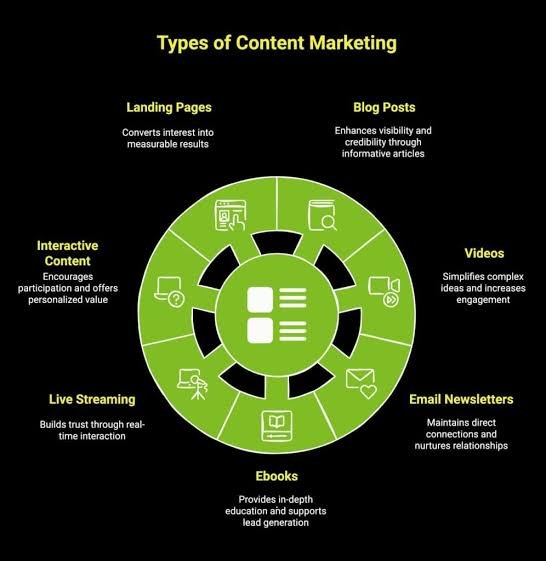
Types of Content Marketing
Businesses can use multiple forms of content depending on their audience and marketing objectives.
Blog Posts: Regular blogs help educate readers, improve SEO, and establish industry expertise.
Videos: Video content explains products, demonstrates services, shares tutorials, and increases engagement across digital platforms.
Infographics: Visual content presents complex information in a simple and attractive format, making it easy to understand and share.
Social Media Content: Posts, stories, reels, and short videos help brands connect with audiences, increase visibility, and encourage conversations.
Email Newsletters: Personalized emails keep subscribers informed about new products, company updates, and valuable educational content.
eBooks and Whitepapers: These detailed resources provide in-depth information and are commonly used to generate leads by offering downloadable content.
Case Studies: Real-life success stories demonstrate how a business solved customer problems and built measurable results.
Podcasts and Webinars: These formats allow brands to share expert knowledge while engaging audiences through discussions and live presentations.
Essential Elements of an Effective Content Marketing Strategy
A successful content marketing campaign requires careful planning rather than random content creation.
Understand Your Target Audience
The first step is identifying the target audience. Businesses should understand customer demographics, interests, challenges, and purchasing behavior. Creating buyer personas helps marketers produce content that addresses specific needs.
Set Clear Goals
Every content marketing strategy should have measurable objectives such as increasing website traffic, generating leads, improving brand awareness, boosting email subscribers, or increasing sales.
Conduct Keyword Research
Keyword research helps identify the topics people search for online. Using relevant keywords naturally throughout content improves search engine visibility without compromising readability.
Create High-Quality Content
Quality is more important than quantity. Effective content should be informative, accurate, engaging, well-structured, and easy to read. Original content that solves real problems performs better than overly promotional material.
Maintain a Content Calendar
Publishing content consistently helps build audience trust and keeps marketing efforts organized. A content calendar outlines topics, publishing dates, and distribution channels.
Promote Your Content
Creating great content is only half the job. Businesses should promote content through social media, email newsletters, online communities, influencer partnerships, and paid advertising when appropriate.
Measure Performance
Analytics tools help measure website traffic, user engagement, conversion rates, bounce rates, keyword rankings, and social media performance. Regular analysis enables marketers to improve future content strategies.
Best Practices for Content Marketing
To maximize success, businesses should follow proven best practices:
- Focus on solving customer problems rather than constantly promoting products.
- Write compelling headlines that encourage readers to click.
- Optimize content for search engines while maintaining readability.
- Include visuals such as images, charts, and videos to improve engagement.
- Use clear calls to action that guide readers toward the next step.
- Update older content to keep information accurate and relevant.
- Repurpose content into multiple formats, such as turning a blog post into a video or infographic.
- Encourage audience interaction through comments, polls, and social media discussions.
Challenges of Content Marketing
Although content marketing offers numerous benefits, it also presents several challenges. Producing high-quality content consistently requires time, creativity, and resources. Competition is intense, making it difficult for businesses to stand out. Measuring return on investment can also be challenging because content marketing often delivers long-term rather than immediate results. Additionally, search engine algorithms and consumer preferences frequently change, requiring marketers to continuously adapt their strategies.
The Future of Content Marketing
Content marketing continues to evolve with advances in technology and changing consumer behavior. Artificial intelligence is helping marketers generate ideas, personalize customer experiences, and analyze performance more efficiently. Interactive content such as quizzes, polls, augmented reality experiences, and live videos is becoming increasingly popular. Voice search optimization, mobile-first content, and personalized recommendations are also shaping the future of digital marketing.
Despite these technological advancements, one principle remains unchanged: businesses that consistently create valuable, trustworthy, and customer-focused content are more likely to earn audience loyalty and achieve sustainable growth.
Conclusion
Content marketing has become one of the most effective ways for businesses to attract, engage, and retain customers in the digital age. By providing valuable information instead of relying solely on traditional advertising, companies can establish credibility, strengthen customer relationships, and improve their online presence. A well-planned content marketing strategy that combines quality content, consistent publishing, audience understanding, and performance analysis can deliver lasting business results. As digital competition continues to grow, organizations that invest in meaningful and relevant content will be better positioned to build trust, increase brand awareness, generate qualified leads, and achieve long-term success.